發表文章

目前顯示的是有「近視雷射手術」標籤的文章

IOL Power Calculations After Keratorefractive Surgery

圖片
  IOL Power Calculations After Keratorefractive Surgery How the Pentacam simplifies an increasingly important task. BY WARREN E. HILL, MD Performing IOL power calculations for eyes with prior RK and LASIK is becoming more and more of a problem for ophthalmologists; in fact, it is something of a tsunami that will wash over many practices. In the US alone, millions of patients have undergone RK and LASIK since these procedures were first introduced, and a significant portion of these individuals are nearing the age at which cataract surgery is becoming commonplace. More than ever, ophthalmologists now need a workable strategy for easily and successfully handling IOL power calculations following all forms of keratorefractive surgery.  A TWO-PART PROCESS  Calculating the IOL power for the postkeratorefractive surgery patient is a two-part process. First, we must estimate the central corneal power as best as we can. The problem with using standard equipment is that keratometer...

台北市醫師公會會刊56卷第11期之糖尿病視網膜病變治療的新趨勢

糖尿病視網膜病變治療的新趨勢 署立基隆醫院 *台大醫院 眼科部 游建章 楊長豪* 前言         由於社會型態及生活習慣的改變與環境的變遷,糖尿病的盛行率逐年上升,糖尿病是開發中及已開發國家失明的主要原因之一。估計目前全世界有超過3億人口患有糖尿病,尤其在亞洲新興國家,其中有1/3在印度及中國。而根據世界衛生組織(WHO)統計糖尿病患比沒有糖尿病的人高出10-20倍的失明機會。在台灣糖尿病視網膜病變也是台灣中老年失明最重要的原因。而不論是第一型或第二型糖尿病的患者,都會受到糖尿病視網膜病變的影響。         在Wi s cons in糖尿病視網膜病變流行病學研究(wisconsin epidemiological study of diabetic retinopathy, WESDR)發現糖尿病視網膜病變的盛行率在第一型糖尿病病患確診三年、五年、十年、十五年後,分別為8%、25%、60%及80%,發病二十年後幾乎全部患者呈現不同程度的視網膜病變。 反觀第二型糖尿病患者於診斷成立之初,就有21%患者有視網膜病變,而且在發病二十年後則有60%患者發生視網膜病變。 糖尿病對眼睛的影響甚多,主要是視網膜病變,尤其以增殖性視網膜病變及黃斑水腫最會危及視力。糖尿病黃斑水腫造成視力損傷約有2.75%,對生活機能及品質的影響巨大。         糖尿病視網膜病目前一般接受的致病機轉如下:糖尿病病人在高血糖的狀況下,會經由polyol (聚醇)及hexosamine(己糖胺)途徑會合成diacylglycerol-prtein kinase C (DAG-PKC)、自由基、及 醣化產物 (advanced glycosylation endproducts, AGEs )。而這些正是糖尿病網膜病變的主要成因1,2。另外,有許多研究顯示,發炎反應在糖尿病網膜病變致病機轉上扮演重要的角色3。而這些途徑被活化後會導致視網膜神經層及視網膜微血管病變。這些影響包括增加細胞凋亡、神經膠細胞活化,及glutamate代...

Acry-sof IQ ReSTOR multifocal TORIC IOL

圖片
AOC 20120624 在Taipei W Hotel Acry-sof IQ ReSTOR multifocal TORIC IOL 有 10% 的人散光> -2.0 裝多焦點人工水晶體注意 -3.0 的病人 注意散光是 Regular or irregular? Topography 每個病人都要做,再做 A –scan 前 , 而且要趁角膜很好的時候先做。 如果 Topography 與電腦驗光 K readings 不合?是不規則? tear film ? corneal   scar ?。 就不放 toric IOL 了! 裝 Restor IOL 有 65% 有 glare or halo vision ,但 65% 沒關係 IQ 遠 100 ,中 0 近 0 Restor IOL 遠 80 ,中 8o 近 8O , biIateral 植入會更佳 NTG, 的 risk factor:female,migraine headache, disc hemorrhage Set target pressure: 也要考慮角膜厚度! 用薬:用效果好的,注意: CME , uveitis , herpes , sulfa drug 過敏 Dry eye : 注意 meibomian gland 的功能 多焦 CL :看遠可以,光線要良好 ,或只有單眼開白內障。 dominant 看遠, non-dominant 看近 提醒病人是多看到了什麼,而不是看不到什麼。 tear film breakup time 対乾眼症的診斷比Schirmer test較準,視力會 fluctuation也是乾眼症的症狀

Femtosecond phenomenon: Burgeoning alternative applications

Femtosecond phenomenon: Burgeoning alternative applications by Maxine Lipner Senior EyeWorld Contributing Editor Considering new possibilities for femtosecond technology from lenticule extraction to etching flaps with the femtosecond laser and more, this technology is making inroads in many areas of ophthalmology, according to Ginny L. Kullman, M.D., assistant professor, Ochsner Medical Center, New Orleans. In the September-November 2010 issue of Seminars in Ophthalmology, Dr. Kullman, together with Roberto Pineda, M.D., assistant professor of ophthalmology, Harvard Medical School, Boston, and director of refractive surgery, Massachusetts Eye and Ear Infirmary, Boston, reviewed the latest advances in this area. “I was doing my fellowship at Massachusetts Eye and Ear and we had a research core review project —the topic was technological advances in the field of ophthalmology,” Dr. Kullman said. “I wanted to target it more to cornea as I was doing a cornea fellowship.” Dr. Kul...

The future of laser-assisted cataract surgery: Clinical results and patient flow

August 2011‧Eye World The future of laser-assisted cataract surgery: Clinical results and patient flow    When a new technology emerges, especially one as advanced and somewhat controversial as femtosecond laser-assisted cataract surgery, surgeons want information. Their most recent source was the ASCRS and EyeWorld-sponsored webinar entitled, "The future of laser-assisted cataract surgery: Clinical results and patient flow."    Alan B. Aker, M.D., Boca Raton Fla., logged on to the webinar with specific questions in mind: Is the femtosecond for cataract laser worth pursuing? Can a business model be developed that will justify the capital outlay necessary to bring one into an already successful cataract practice? How do surgeons present or "sell" this to their patients? "A desire to get answers to these questions is what is driving many of us to participate in these webinars, since there is very little experience with the laser," Dr. Aker said. "...

Challenging refractive cases Dodgy DLK diagnosis

圖片
August 2010‧EyeWorld Challenging refractive cases Dodgy DLK diagnosis by Maxine Lipner Senior EyeWorld Contributing Editor                                                        Eye with diffuse interface fluid syndrome Source: Richard L. Lindstrom, M.D. It must have seemed like an easy diagnosis, a no-brainer even. Following bilateral LASIK for high myopia, a 31-year-old man returned a few days later complaining of blurry vision with his eyes showing mild irritation. Initially the patient had acuity of 20/30 in both eyes, with an intraocular pressure of 18mmHg. The surgeon here concluded that this was yet another case of DLK and treated the patient with intense steroids, placing him initially on 1 percent prednisolone acetate to be taken every two hours. At the 3-week post-op mark, however, no improvement was see...

Challenging refractive cases A case of isolated epithelial ingrowth nests?

圖片
 August 2010‧EyeWorld Challenging refractive cases A case of isolated epithelial ingrowth nests? by Michelle Dalton EyeWorld Contributing Editor Frustration mounts as a recurrent epithelial ingrowth is evasive to treat    It all seems to go according to plan—the patient is evaluated for LASIK, is determined to be a good candidate, the surgery scheduled, the microkeratome-created flap and subsequent laser correction are completely uneventful, immediate post-op indicates this is yet another successful surgery. But then the woman returns a couple of months later with an epithelial ingrowth. Instinct tells the surgeon to lift and scrape and that will be that. About 6 weeks later, however, the woman returns with an epithelial ingrowth in just about the same spot as the original. Again, the surgeon presumes he might have missed a cell or two the first time, so he lifts, scrapes, replaces one more time. He notes the epithelial cells seem to be very central, with no visibl...

A decision tree of VKC

圖片
Photophobia is, however, an important factor in determining a patient's VKC grade. Grade0, Grade1: antihistamine, tear substitutes Grade2: fluorometholone Grade3, Grade4: loteprednol, prednisolone acetate

Phakic intraocular lenses

圖片

Long-term Comparison of corneal aberration changes after laser in situ keratomileusis:Mechanical microkeratome versus femtosecond laser flap creation

圖片

Laser in situ keratomileusis flap complications using mechanical microkeratome versus femtosecond laser: Retrospective Comparison

圖片

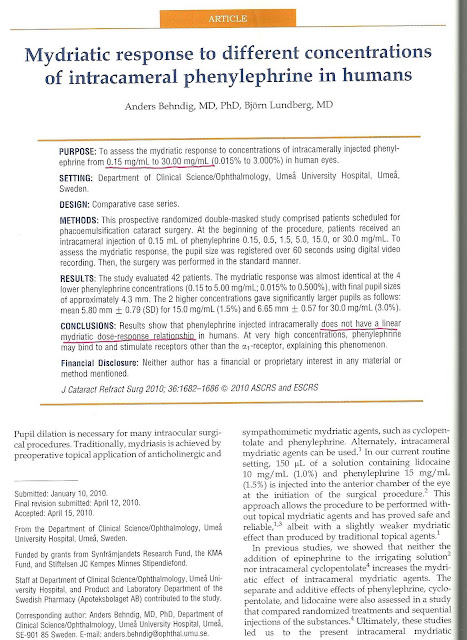
Mydriatic response to different concentrations of intracameral phenylephrine in humans

圖片
Intracameral mydriatic should not be less than 15.0mg/ml (1.5%)

Anterior segment parameters: Comparison of 1-piece and 3-piece acrylic foldable intraocular lenses

圖片
3-piece IOLs shifted forward significantly after surgery but 1-piece IOLs did not.

Drill-and-crack technique for nuclear disassembly of hard nucleus

圖片
An Akahoshi prechopper is insert into the hole.