發表文章

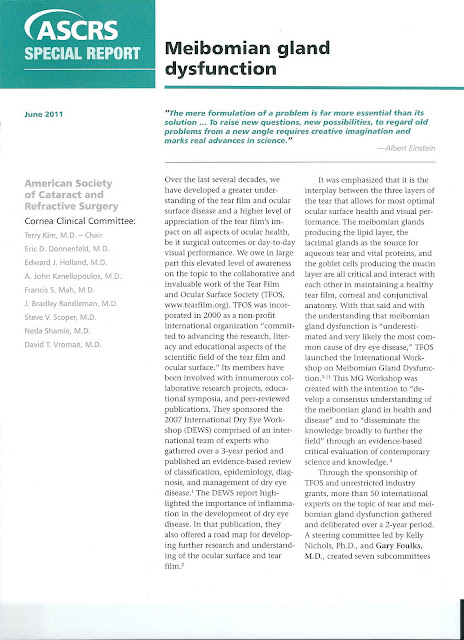
Meibomian gland dysfunction

圖片

Cataract and glaucoma don't go together like a horse and carriage

圖片
[June 2011 EyeWorld] Cataract and glaucoma don't go together like a horse and carriage by Matt Young EyeWorld Contributing Editor There are problems treating both diseases in the same patient, but modern solutions exist      A new report refers to cataract as the "silent enemy" in relation to glaucoma and trabeculectomy surgery, and it's no wonder why. In a nutshell, cataract formation is likely after trabeculectomy surgery. Subsequent cataract surgery leads to frequent bleb failure. Cataract surgery in patients requiring filtration surgery remains an issue of contention, according to the report, published online in January in the British Journal of Ophthalmology. "Cataract should not remain the silent enemy of successful trabeculectomy surgery," lead author Rashmi G. Mathew, M.R.C.Ophth., Moorfields Eye Hospital, London, said in the report. "Reviewing the literature does provide clarity on some issues surrounding this topic."    It's...

Presbyopia-correcting IOL pearls

圖片
[June 2011 EyeWorld] Presbyopia-correcting IOL pearls by Faith A. Hayden EyeWorld Staff Writer  An implanted ReSTOR IOL (Alcon) Source: Richard Tipperman, M.D.     No matter which presbyopia-correcting IOL you favor, be it the ReSTOR (Alcon, Fort Worth, Texas), Tecnis (Abbott Medical Optics, AMO, Santa Ana, Calif.), or Crystalens (Bausch & Lomb, Rochester, N.Y.), experts agree that achieving the best possible outcomes begins with one critical component: the pre-op exam. EyeWorld spoke with Richard Tipperman, M.D., Wills Eye Hospital, Philadelphia; Y. Ralph Chu, M.D., adjunct associate professor of ophthalmology, University of Minnesota, Minneapolis, and clinical professor of ophthalmology, University of Utah, Salt Lake City; and William B. Trattler, M.D., cornea specialist, Center for Excellence in Eye Care, Miami, for tips on attaining spectacular outcomes with each and every patient. The feedback was largely universal. Proper patient selection and an extensive ...

Cataract surgery may benefit Alzheimer’s patients

     Cataract Surgery may Benefit Alzheimer’s patients A group of French researchers presented findings that patients with mild Alzheimer's disease whose vision improved after cataract surgery also showed improvement in cognitive ability, mood, sleep patterns, and other behaviors. Presenting last week at the American Academy of Ophthalmology meeting, Brigitte Girard, M.D. , said hers is the first study to specifically assess whether cataract surgery could benefit Alzheimer's patients, although earlier research had shown that poor vision is related to impaired mood and thinking skills in older people and that cataract surgery could improve their quality of life. She enrolled 38 patients (average age: 85 years) who all exhibited mild dementia due to Alzheimer's disease. All participants had a debilitating catara...

Retinoic acid may be key to dry, wet AMD treatments

圖片
Retinoic acid may be key to dry, wet AMD treatments by Michelle Dalton EyeWorld Contributing Editor ------------------------------------------------------------ Patients receiving the 300 mg dose of fenretinide showed significant reduction of retinol binding protein and reduced lesion growth from baseline when compared to placebo Source: ReVision Therapeutics A synthetic retinoid derivative has been able to slow lesion growth and preserve visual acuity in patients with geographic atrophy (GA). Further, when the patients were able to achieve sustained reductions in retinol binding protein (RBP) levels of 60-75% (indicating a positive response to fenretinide), these same patients had a lesion growth rate of about half what those receiving placebo experienced when the RBP reduction threshold was met. "Fenretinide may improve clinical outcomes for patients with both dry and wet forms of age-related macular degeneration," said Jason Slakter, M.D., clinical professor of ophth...

Steroid reliance too common in treating uveitis

圖片
Steroid reliance too common in treating uveitis by Jena Passut EyeWorld Staff Writer -------------------------------------------------------------------------------- Although steroids are useful in treating uveitis (pictured here), long-term use results in side effects, such as cataracts Source: Manolette Roque, M.D. More training with uveitis experts is needed; disease is curable with immunosuppressive therapy Despite major inroads in the treatment of many ocular diseases, uveitis rates have remained nearly the same for the past 35 years. The disease has an estimated prevalence of 38 in 100,000. Of that, 10% of patients will become blind. "The reason that there has been no significant progress in driving down the prevalence in developed countries around the world is because of the exclusive reliance on steroid therapy by the bulk of ophthalmologists who care for patients with uveitis," said C. Stephen Foster, M.D., clinical professor of ophthalmology, Harva...
圖片
Deciphering dry eye therapies by Faith A. Hayden EyeWorld Staff Writer -------------------------------------------------------------------------------- Dry eye syndrome (DES) is one of the most common reasons a patient presents to an ophthalmologist's office. It affects 10-15% of U.S. adults, or about 80 million people. DES usually affects post-menopausal women, adults over the age of 65, and younger individuals who wear contacts for extended periods of time. Other diseases such as diabetes, rheumatoid arthritis, lupus, and Sjogren's syndrome can also bring on DES. There is no perfect or agreed-upon solution for the disease, and every doctor seems to have his or her own preferred management method. Treatment for this condition varies wildly, often depending on the cause of the disease, severity of the symptoms, and lifestyle of the patient. When deciding which therapy to prescribe to a patient suffering from the itchiness, redness, and pain associated with this cond...